Designing a spending clarity app from zero
Role — Sole Product Designer
Type — Concept Project
Timeline — 3 Weeks
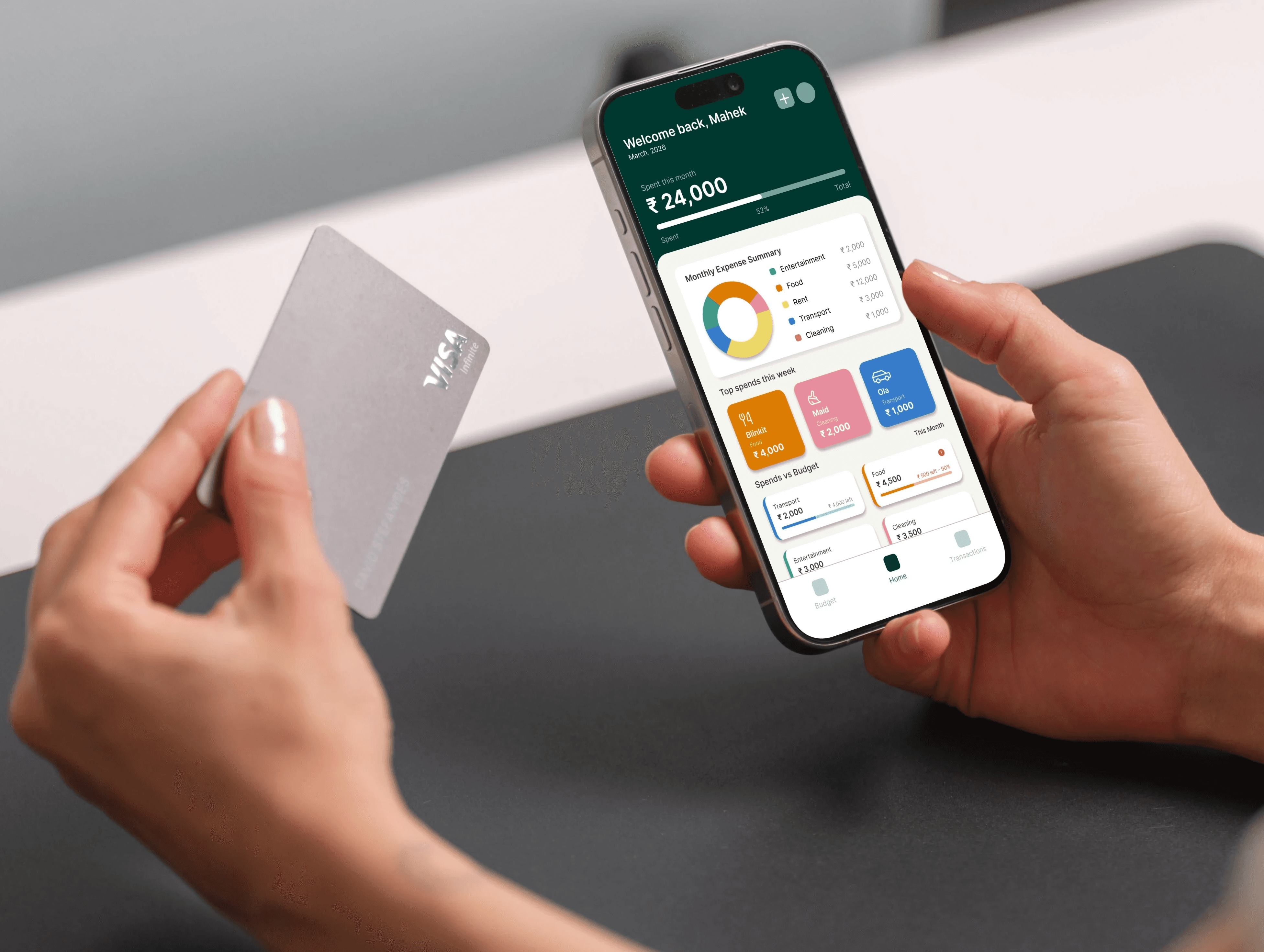
Sorted. started with a simple question: Why aren’t existing money apps working for the people who use them? Many are cluttered, raise privacy concerns, or rely on tedious manual tracking. I wanted to explore what a simpler, more focused personal finance experience could look like.
Research with 35 respondents revealed that spending clarity -not more budgeting or investment features - was the bigger gap. Usability testing then shaped the product: Goals was descoped when testing showed it solved a different problem, while Quick Add became persistent after users needed an easier way to record expenses from anywhere in the app.
The result is a privacy-first personal finance app built around how people actually track and understand their spending.
OVERVIEW
UPI made spending effortless. Tracking it never caught up.
I first noticed this in college. I'd download Goodbudget, diligently log every chai and auto ride for a few days, then quietly stop. The app wasn't the problem; it just asked for more effort than real life allowed.
80%
of respondents actively try to track their expenses, yet over half rely on memory and cited manual entry as too tedious to sustain (based on primary research).
THE PROBLEM
If spending is effortless, why does tracking money still feel like work?
The RBI's 2023-24 Report on Currency and Finance flags it directly - digitalisation has accelerated spending behaviour faster than budgeting habits can follow. UPI transactions crossed 100 billion in FY24. Most people still check their balance and hope for the best.
Existing apps haven't solved this. They demand manual entry that can't keep pace with digital spending, offer bank syncing that users don't trust, and bury people in cluttered interfaces built around categories that don't reflect how Indians actually spend.

RESEARCH
People aren't avoiding budgeting. They're avoiding the friction.
I surveyed 35 respondents across students, early-career professionals, and senior professionals, then spoke personally to people around me to understand the nuance behind the numbers.


People want less effort……

……but they also want control
RESEARCH
Existing tools make tracking possible, but rarely make financial awareness sustainable.
Based on hands-on evaluation of Axio, Jupiter, and GoodBudget, supported by Play Store reviews, Reddit discussions, and articles on Indian personal finance behaviour

OPPORTUNITY
Every existing tool solves one problem by creating another. Automation comes at the cost of privacy. Intentional budgeting demands manual effort. Rich features add clutter. The opportunity was to combine these strengths into one experience without inheriting their compromises.


GOAL
Sorted exists to replace guesswork with clarity. Every time users open the app, they should immediately understand where their money went, how they're spending, and what to do next. Over time, it helps transform financial awareness from a one-time task into a lasting habit.
STYLE GUIDE
A visual language that reinforces clarity
I wanted the interface to feel immediately familiar through a trusted green foundation, while purposeful colour accents created an interface that feels approachable without becoming visually overwhelming

PROTOTYPE
The product, in motion
ONBOARDING & SET UP
Onboarding was reduced to the essentials, helping users reach value with minimal setup
SIGN UP & APP INTRODUCTION


Three intro screens give first-time users a quick sense of what the app does before they commit to setting it up
B. BANK LINKING & CATEGORY SET UP


Sync choice and bank linking combined into one screen. Skipping is always an option for manual users.
HOME DASHBOARD
Every element on the dashboard was prioritised around what users wanted to see first


TRANSACTIONS
Automation does the heavy lifting, while users stay in control of the details


BUDGET
The budget tab brings together limits, trends, and insights into one live view of monthly spending


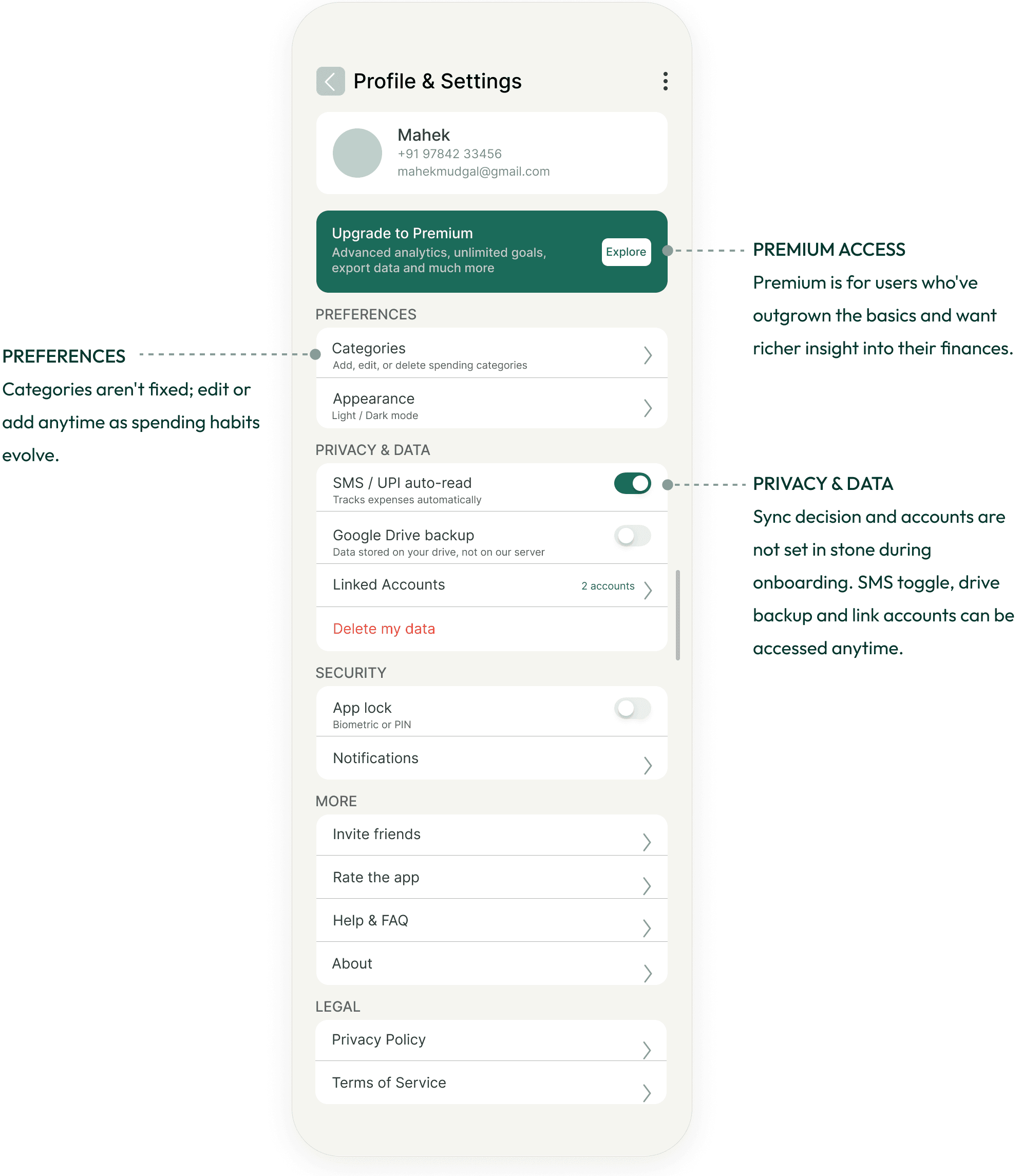
QUICK ADD & PROFILE
Logging and settings stay accessible without disrupting the flow

Capture an expense in three simple steps

REFLECTIONS
Habit Formation & Retention
Sorted has a clear trigger (daily nudge) and a clear action (log or review). What it lacks is a variable reward - something that makes opening the app feel worth it beyond utility. Feedback from a startup founder raised this directly: apps fail when they stop giving users a reason to return. Streaks, spending milestones, weekly insight cards, or a creator-driven financial content layer are all directions worth exploring. The deliberate choice in V1 was to prove clarity alone could retain users, but whether that holds at scale remains the open hypothesis.
FUTURE CONSIDERATIONS
Saving clarity
Spending clarity is the foundation. The natural next step is a dedicated space for goals, investment tracking, and long-term planning, built with the same intentionality, not bolted on.
AI categorisation accuracy
Inconsistent merchant naming in India's UPI ecosystem puts a ceiling on accuracy across every app in this space. Future iterations would explore merchant data partnerships or crowdsourced correction to close this gap.
Accessibility and regional languages
Sorted was designed in English for urban Indians, a significant constraint. Regional language support and assistive interactions would meaningfully expand who the product actually serves.
Premium tier
Deeper spending breakdowns, export tools, and curated financial content, kept entirely separate from the core experience so the free product never feels limited.
Reward mechanics
Explore lightweight incentive loops such as weekly spending summaries, milestone acknowledgements, or a financial creator content layer, without compromising the ad-free, clutter-free core experience.